.png)
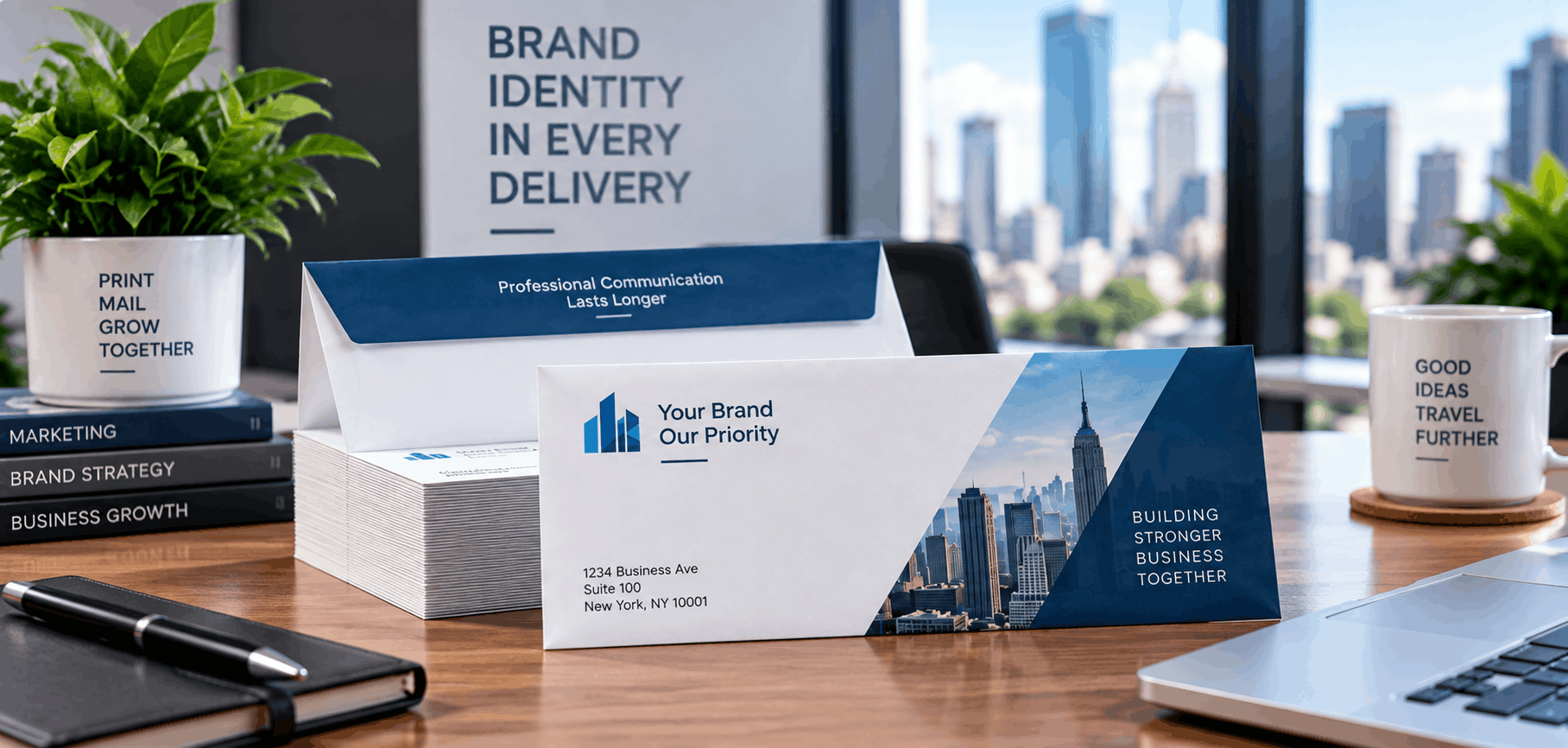
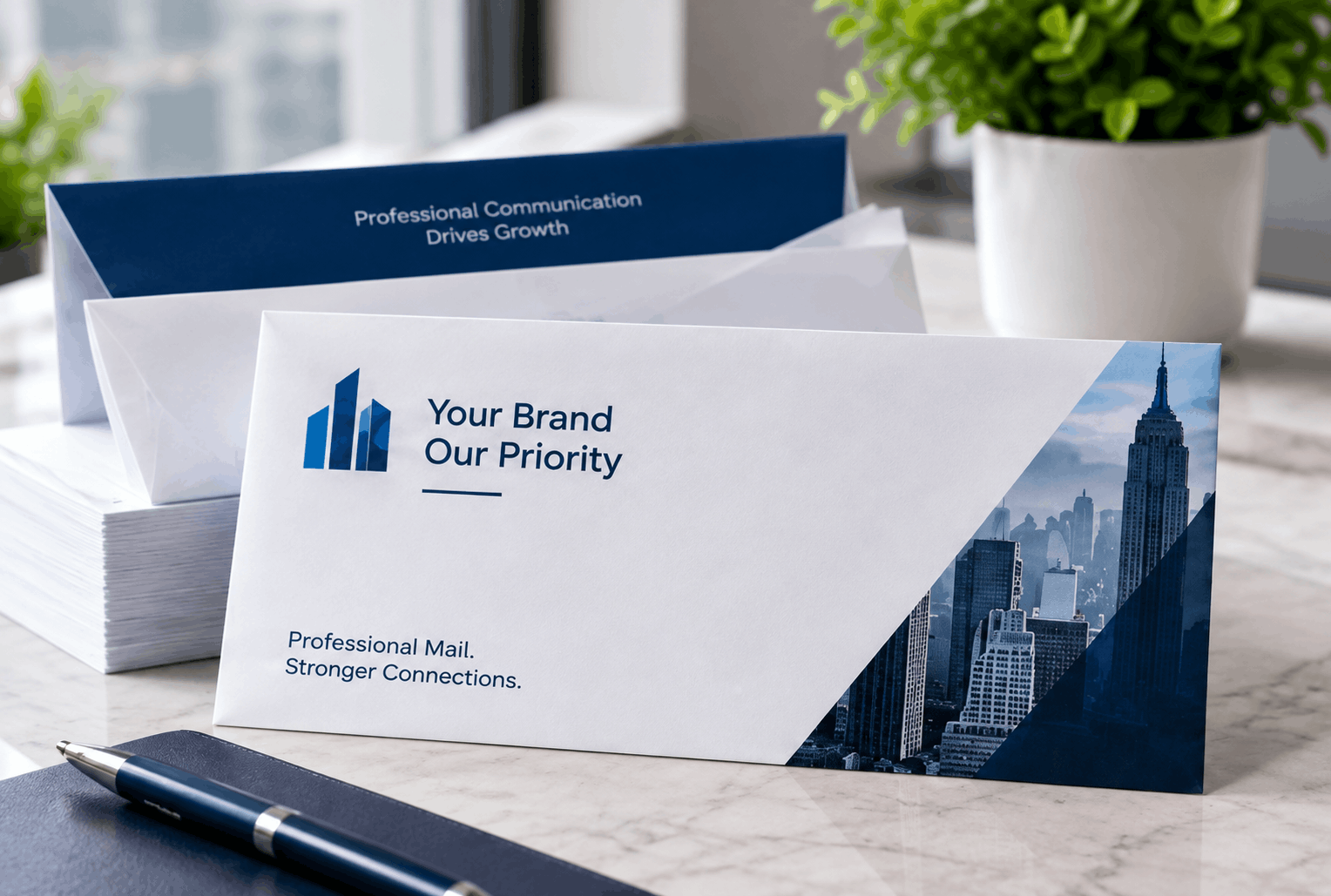
Business mailing envelopes strengthen brand identity and professional communication because they are often the very first physical touchpoint a client or prospect has with your company, long before they open what is inside. A plain white envelope gets sorted into the same pile as every other piece of mail, while business mailing envelopes printed with your logo, colors, and design signal that a real, established company is on the other end. By the time the flap is opened, the recipient has already formed an opinion about who sent it.
This matters more now than it did a decade ago. Inboxes are crowded and digital ads are easy to scroll past, but a well-designed envelope still has to be physically handled before it can be ignored or opened. Companies that invest in branded mailing envelopes are using one of the few remaining moments where a recipient's full attention is guaranteed, even if only for a second or two.
Most businesses spend significant time perfecting the letter, invoice, or offer inside an envelope, then send it out in generic packaging. That gap matters because the envelope is opened, or ignored, before any of that content is ever seen.
Choosing the right print method affects both the final look of your envelope and the overall cost of the campaign.
Offset printing uses CMYK process color to reproduce logos, brand patterns, and photography with sharper detail and more accurate PMS color matching than short-run digital methods. This makes it the standard choice for corporate mailings, fundraising appeals, and any campaign where consistent brand color across thousands of pieces is non-negotiable. Digital printing, on the other hand, is better suited to smaller runs or projects that need a faster turnaround without the higher setup cost of an offset run. For high-volume direct mail envelope printing, offset remains the more economical and color-accurate option per piece.
Custom printed envelopes are not limited to marketing mailers. They play a role anywhere your company sends physical mail that reflects on the brand.
Businesses running larger outreach campaigns often pair branded envelopes with direct mail services to manage design, printing, and distribution as one coordinated effort.
A logo alone is not enough to make a mailing envelope feel like part of a cohesive brand. The details below tend to separate an envelope that reads as branded from one that just has a logo stamped on it.
Matching your envelope design with branded letterheads reinforces the same visual identity from the outside of the mail piece to the document inside it.
Envelopes rarely travel alone. They are usually paired with a letter, invoice, or promotional insert, which means visual consistency across the entire mail piece matters as much as the envelope itself.
Coordinating your envelope printing with the rest of your business stationery, including letterheads and business cards, ensures that every piece a client receives reflects the same brand standards. This consistency is especially important for professional services firms, financial institutions, and healthcare practices, where every printed touchpoint contributes to perceived credibility.
Getting a clean, professional result depends on a few decisions made before the design process even begins.
Working through these steps in order catches the issue that causes the most reprints: artwork that lines up perfectly on a screen but shifts out of place once the envelope is folded and sealed.
Most marketing budgets go toward what is written inside a mailer, while the envelope carrying it gets an afterthought. Copies America takes the opposite approach, producing full color, offset-printed envelopes built for corporate mailings, event invitations, and fundraising campaigns that need consistent, accurate brand color at scale. Whether you are refreshing your entire stationery suite or printing a single campaign, Copies America can walk you through size, stock, and turnaround options that fit your timeline. Contact Us for custom envelope printing to get a template started and a quote for your next mailing.
Business mailing envelopes are custom-printed envelopes used for corporate correspondence, direct mail campaigns, invitations, and client communication. They typically feature a company's logo, brand colors, and design elements printed directly on the envelope face to reinforce brand identity before the recipient opens the mail.
Offset printing is generally the better choice for large runs that require precise, consistent brand color across thousands of pieces. Digital printing works well for smaller batches or projects with a tighter turnaround, since it avoids the higher setup cost associated with offset production.
Yes. A full color, branded envelope stands out against plain white mail and signals legitimacy, which can meaningfully increase the likelihood that a recipient opens it rather than setting it aside. This effect is especially noticeable in donor appeals and marketing campaigns competing for attention.
Standard sizes including #10, #9, 6x9, and 9x12 envelopes are USPS mailable as long as the design leaves the required clearance zones open, particularly the bottom area used for postal barcode scanning. Requesting a template before designing helps ensure your artwork meets these requirements.
Offset-printed envelopes typically ship within 5 to 7 business days after artwork approval, with rush production available for time-sensitive campaigns. Turnaround can vary based on quantity, coating, and whether a proof is requested before the order goes to press.
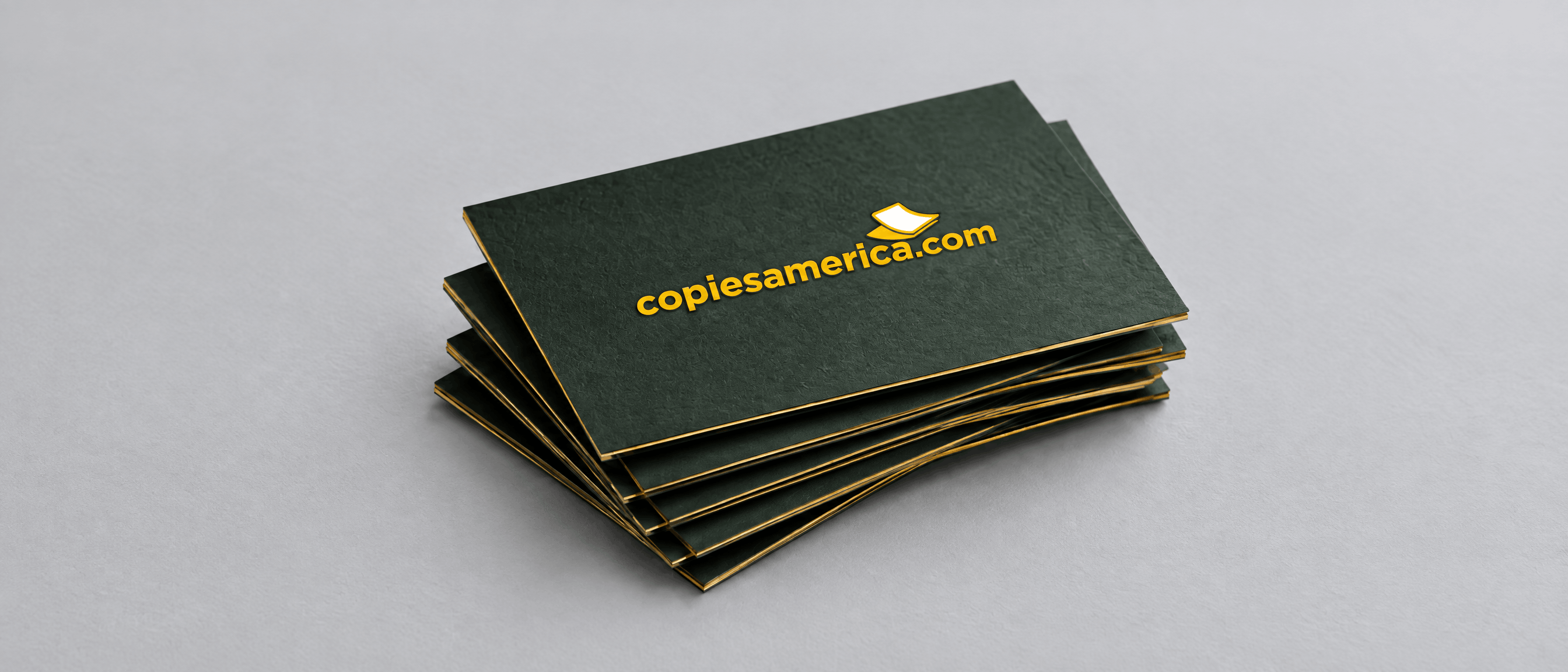
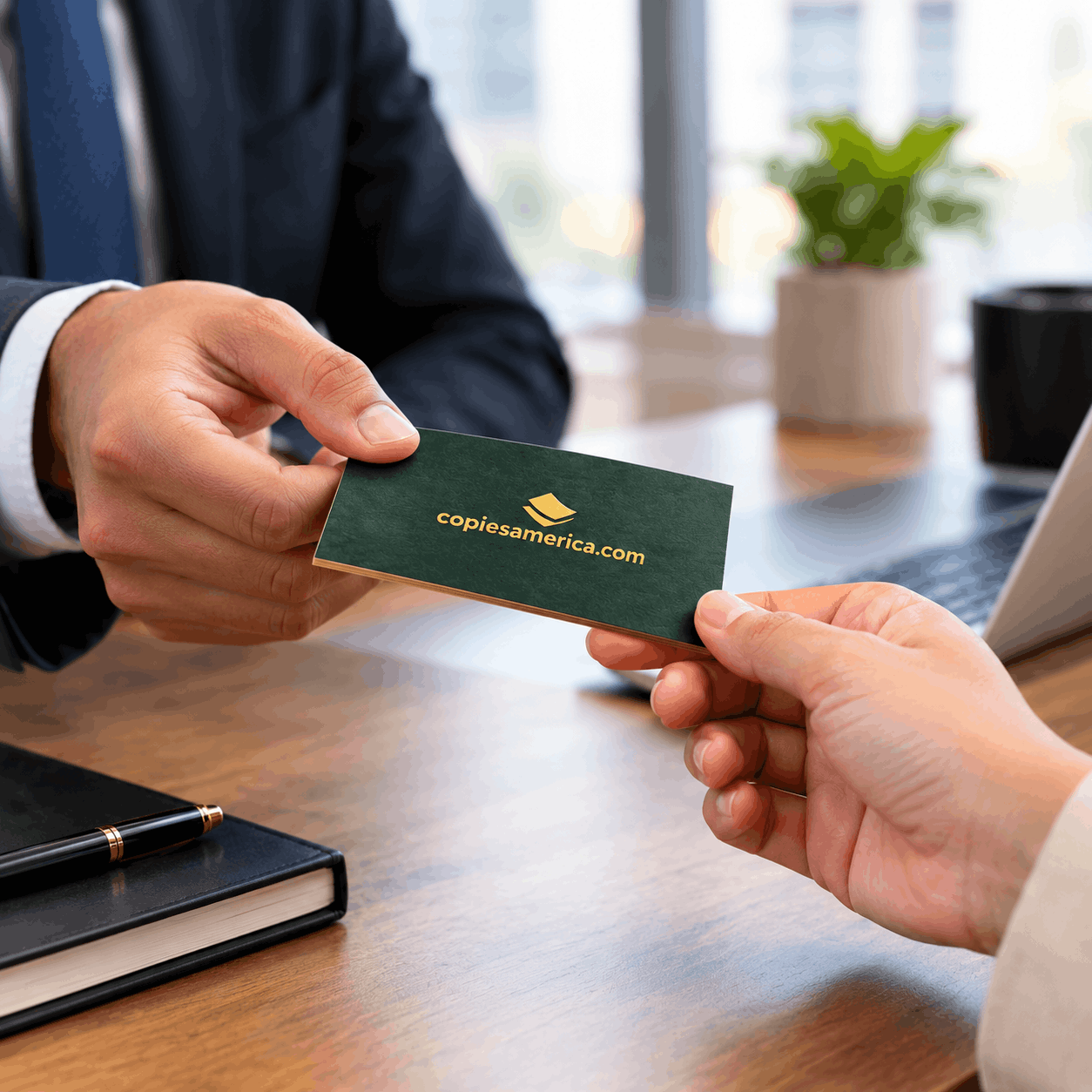
Thick business cards are becoming a popular choice for professional branding in 2026 because their weight, texture, and durability create a stronger first impression than standard cardstock ever could. Business owners are moving away from thin, forgettable cards and toward thick business cards that feel substantial the moment someone picks one up. This shift matters because a business card is often the only physical touchpoint a prospect keeps after a meeting, and a flimsy card rarely earns a second look.
As competition for attention grows across every industry, professionals are realizing that print quality still shapes how a brand is perceived. A card that feels premium in the hand signals that the business behind it takes quality seriously. That is why more architects, consultants, real estate agents, and executives are upgrading their stationery instead of settling for whatever their local print shop stocks by default.
Cardstock thickness is measured in points (pt), with each point representing roughly one-thousandth of an inch. Standard business cards typically run between 14pt and 16pt, while premium thick cards start at 24pt and go up to 32pt.
At 32pt, a card is often layered rather than printed on a single sheet, which is part of what allows for features like a solid painted color along the edges.
Digital contact sharing has made physical cards less common, which paradoxically makes the ones that are handed out matter more. When a business card is rare, it needs to work harder.
Not every business needs the heaviest cardstock available, but certain industries see a clear return on the investment.
Choosing between a standard card and a thicker option comes down to how the card will be used and who will receive it.
Standard 14pt to 16pt cards are practical for high-volume distribution, trade show tables, or internal team use where cost per unit matters more than tactile impact. Thicker cards, by contrast, are better suited to one-on-one meetings, client pitches, and situations where the recipient is likely to keep the card rather than toss it. Many businesses order both: a standard run for general use and a premium run of thick business cards for leadership or client-facing roles.
Thickness alone creates a strong first impression, but the finishing details are what make a card memorable.
Pairing a thick card with matching business stationery helps a brand stay consistent across letterheads, envelopes, and other client-facing materials.
Thick business cards tend to perform best in settings where the recipient has time to notice the details, rather than environments where cards are collected quickly and rarely revisited.
A business attending a trade show may still hand out standard cards in bulk, then reserve thicker cards for warmer leads and decision makers they meet on the floor.
Getting a premium result depends on more than just picking a heavier paper option.
Businesses that are not confident designing the layout themselves can lean on professional graphic design support to make sure the card's visual weight matches its physical weight.
A business card only gets one chance to represent your brand in someone's hand, and thick business cards are built to make that moment count. Copies America produces these cards on premium layered cardstock with custom edge coloring, so every detail, from thickness to finish, reflects the same level of quality your business delivers to clients. Whether you are refreshing your entire team's business cards or ordering a small premium batch for leadership, Copies America can match the production to your goals. Reach out through Contact Us to talk through paper stock, edge color, and turnaround time for your next order.
A thick business card typically starts at 24pt cardstock and goes up to 32pt, which is more than double the thickness of a standard 14pt card. At 32pt, cards are often layered rather than single-sheet, giving them extra rigidity and a premium feel in hand.
Yes, thick business cards generally cost more per unit than standard cards because they use more material and often include finishing work like edge painting or lamination. Many businesses offset this by ordering smaller batches reserved for client meetings rather than mass distribution.
A painted edge business card is a thick, layered card finished with a solid color painted along all four edges. The color is visible even when cards are stacked, making the card stand out before it is picked up or read.
Thick business cards can be worth it for small businesses in client-facing or competitive industries, such as real estate, design, or consulting, where a memorable first impression drives referrals. For internal use or high-volume handouts, a standard card is often the more practical choice.
Most thick business card orders, including layered and edge-painted options, ship within 3 to 5 business days after artwork approval. Rush production is often available for businesses that need cards sooner for an event or meeting.

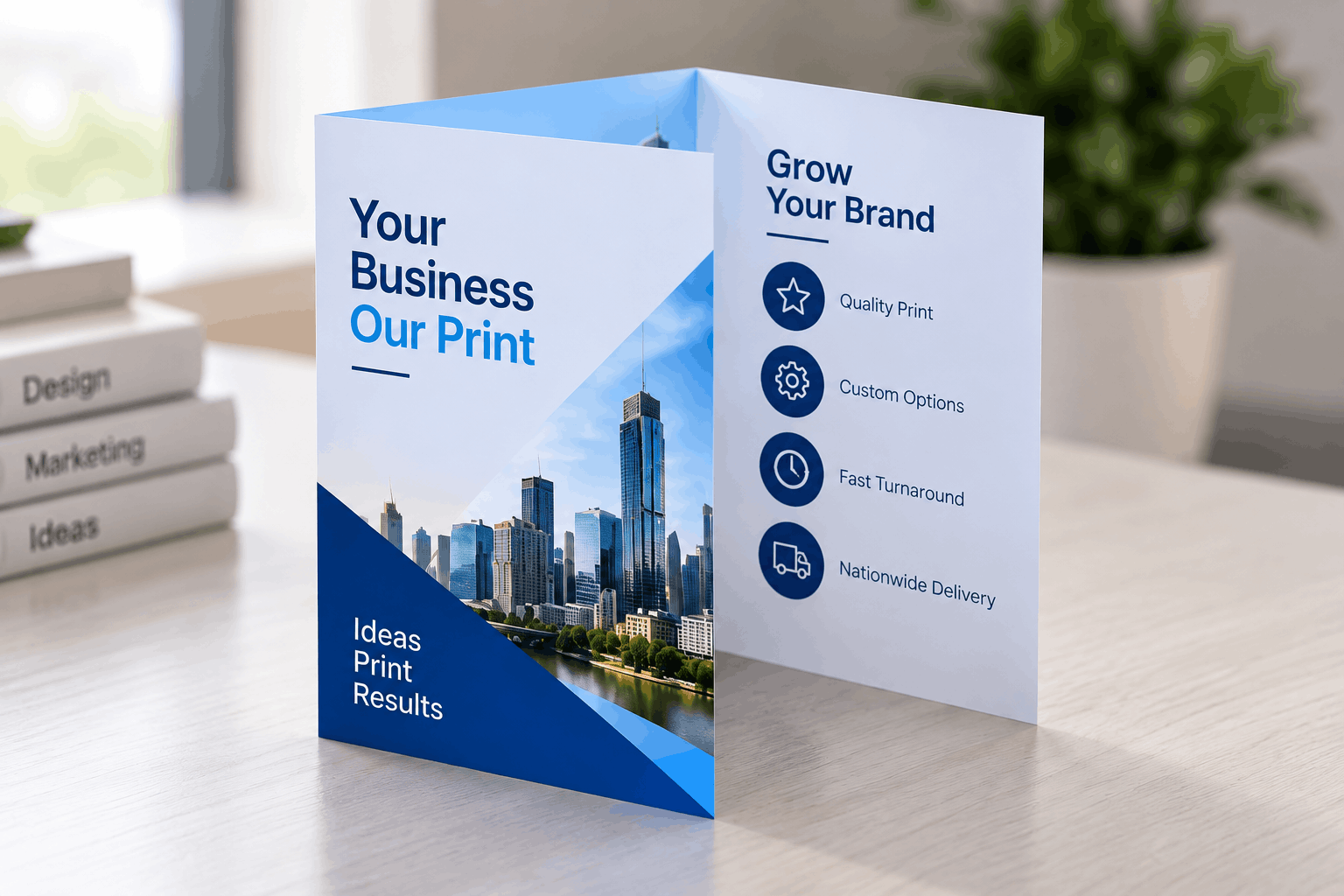
Bi fold brochure printing helps businesses present products more effectively because a single center fold leaves four wide panels instead of the narrower strips other brochure styles produce, so a photo or product shot has genuine room to register instead of getting cropped down to fit. Folding one sheet in half is a simple production step, but the payoff is real estate: a panel that can hold a full product image, a short paragraph, and a bit of breathing room around both. Bi fold brochure printing turns that extra space into a practical advantage for any business trying to sell something visually rather than through a wall of text.
That advantage shows up most for businesses whose offerings depend on being seen rather than read about. A restaurant plating a signature dish, a real estate agent showing a property from multiple angles, or a manufacturer displaying a product line all need panels wide enough for the image to do the convincing. Bi fold brochure printing keeps that visual weight intact without forcing a business into extra folds, smaller panels, or a layout that fights the content it's supposed to showcase.
A bi fold brochure is created from a single flat sheet folded once at the center, producing four equal panels: a front cover, two interior panels, and a back cover.
Because the panels are larger, the format tends to favor content that benefits from visual storytelling over content built around a long list of bullet points.
Certain types of content consistently perform better in a bi fold layout than in a smaller or more segmented brochure:
If your content depends on the reader seeing a clear, well-lit photo rather than skimming a dense paragraph, this is usually the format worth starting with.
Businesses often default to whichever brochure style they have used before without weighing it against the alternative.
Businesses building out a full print marketing kit sometimes pair a bi fold piece with brochures in other formats to cover both a visual overview and a more detailed service breakdown.
The paper stock a business selects changes how a bi fold brochure feels before the reader even opens it.
Matching the paper finish to the tone of the business, polished and premium versus warm and approachable, is often what separates a brochure that feels intentional from one that feels generic.
A larger panel is only an advantage if the layout actually takes advantage of the extra space.
Businesses without an in-house designer often bring in graphic design support to make sure panel layout, image placement, and fold lines are handled correctly before the file goes to press.
File setup errors are one of the most common causes of delayed brochure orders, and most of them are avoidable with a few basic checks.
Businesses ordering brochures alongside other sales materials, such as business cards, often find it more efficient to submit everything as one coordinated order so paper stock and finish stay consistent across pieces.
A brochure only works as hard as the format allows it to. Copies America handles bi fold brochure printing on a range of paper stocks and finishes, with fast turnaround for businesses working toward a launch date, event, or sales push. Whether you already have print-ready artwork or need help planning the layout, the Copies America team can walk through paper, coating, and file setup before anything goes to press. Contact Us to talk through your project and get a quote for your next print run.
Bi fold brochure printing produces a brochure from a single sheet folded once down the center, creating four equal panels: a front cover, two interior panels, and a back cover. The larger panel size compared to other fold styles makes it well suited to photography-heavy or visually driven content.
A bi fold brochure has four larger panels from one center fold, while a tri-fold divides the sheet into three narrower panels. Bi folds work better for large imagery and shorter copy, while tri-folds suit longer, more segmented content like service lists.
Gloss text stock is the most common choice for vibrant color and photography, while matte stock suits a more understated, professional look for services like law or healthcare. Heavier cover-weight stock is available for a more premium, substantial feel.
Standard turnaround typically runs 3 to 5 business days from file approval, with rush production available for tighter deadlines. Submitting a complete, print-ready file with correct bleed and resolution on the first try is the most reliable way to stay on schedule.
Restaurants, real estate agencies, event organizers, and product-focused businesses are among the most common users of the bi fold format. Any business whose message depends on strong photography or a cleaner, more open layout tends to benefit from the larger panel size.
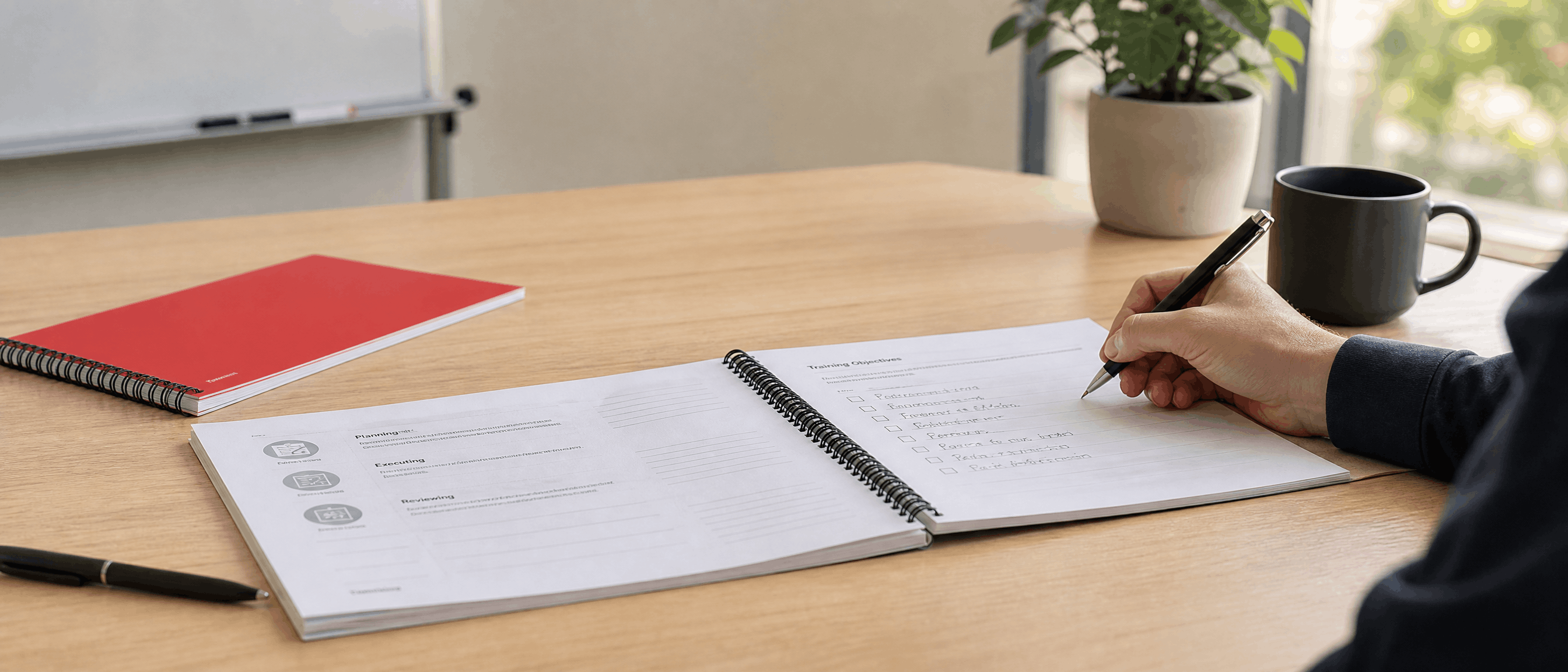
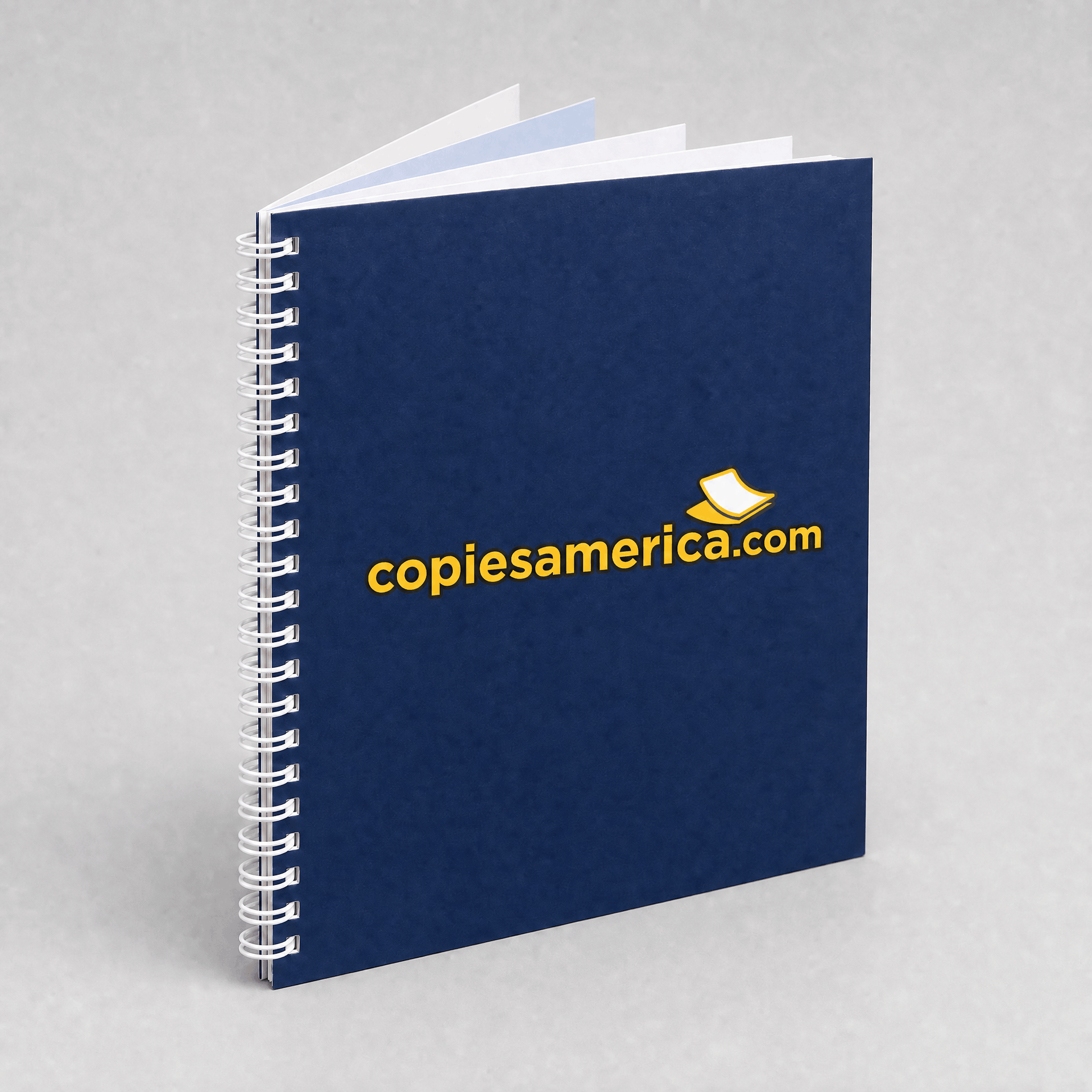
Spiral bound booklet printing is the right choice for your business when your document needs to lay completely flat while someone is actively writing in it, flipping through it at a desk, or referencing it hands-free during daily use. Training manuals, workbooks, and reference guides all share this same practical requirement, and spiral bound booklet printing is built specifically to meet it, using a coil threaded through punched holes so any page opens flat without cracking a spine or fighting to stay open.
Picking a binding style is not just a cosmetic decision. It affects how a document performs in the hands of the person actually using it, whether that is an employee working through a training packet, a customer flipping through a cookbook, or a technician referencing a field manual on the job. Choosing spiral binding for the wrong project can leave you with a booklet that looks fine on a shelf but frustrates the person trying to use it, which is why understanding when this format actually earns its place matters before placing an order.
Spiral binding, sometimes called coil binding, works by punching a row of holes along one edge of the stacked pages and threading a continuous plastic or metal coil through them.
This mechanical simplicity is exactly why the format holds up so well for documents that get handled, written in, and referenced repeatedly rather than displayed. It's also the main reason spiral bound booklet printing remains the default recommendation for anything meant to stay open and usable on a desk or counter.
Not every project needs a booklet that lays flat and folds back on itself, but plenty of common business documents genuinely do:
If your document falls into any of these categories, a flat-opening, durable spine tends to matter more than a printed spine label or shelf presentation.
Businesses often default to whatever binding they have used before, without weighing it against the alternatives.
The right answer depends less on which binding looks most impressive and more on how the finished piece will actually be used once it leaves your printer.
A well-chosen cover changes how a spiral bound piece feels in someone's hands, even though the binding style itself stays functional rather than decorative.
These choices are small individually, but together they determine whether a spiral bound piece reads as professional or purely functional.
File setup for spiral binding has a few requirements that differ from other booklet formats, and getting them wrong is one of the most common causes of production delays.
Businesses producing higher volumes often route these jobs through digital printing for shorter runs or faster turnaround, while larger print quantities may be more cost-effective through traditional offset printing instead.
Booklet projects rarely happen once. Most businesses reorder training materials, workbooks, or reference guides on a recurring basis, so planning ahead saves time later.
Treating booklet printing as a recurring need rather than a one-time purchase tends to make future orders simpler and more predictable.
Choosing the right binding is the difference between a booklet that gets used every day and one that ends up shoved in a drawer. Copies America produces spiral bound booklet printing alongside wire-o, perfect, and saddle-stitch options under one roof, with cover stock, coil color, and page count options built around how your document will actually be used. Whether you are printing your first training manual or reordering a workbook your team relies on, the Copies America production team can walk you through binding, cover, and file setup before anything goes to press. Contact Us to get a quote and a template suited to your project.
Spiral bound booklet printing works best for documents that need to lay completely flat while in use, such as training manuals, workbooks, and reference guides. The coil binding allows a 360-degree fold, so the piece stays open on a desk or counter without being held or weighted down.
Spiral binding has no fixed page limit, which sets it apart from saddle-stitch binding that tops out around 64 pages. Because the coil accommodates any thickness of punched pages, spiral binding works equally well for a short workbook or a lengthy field manual.
Yes, individual pages can be threaded onto or removed from the coil after binding, which is not possible with glued or stapled formats. This makes spiral binding a practical choice for reference documents or price lists that are updated periodically.
Spiral binding is functional but not typically the most polished option for client-facing materials, since the coil is visible and there is no printable spine. Wire-O binding offers a similar flat-opening functionality with a cleaner, more symmetrical appearance better suited to proposals and portfolios.
Files for spiral binding need a clear margin of at least three-eighths of an inch along the edge where holes will be punched. Text, logos, and images should stay outside that zone to avoid being clipped or obscured once the coil is threaded through the pages.
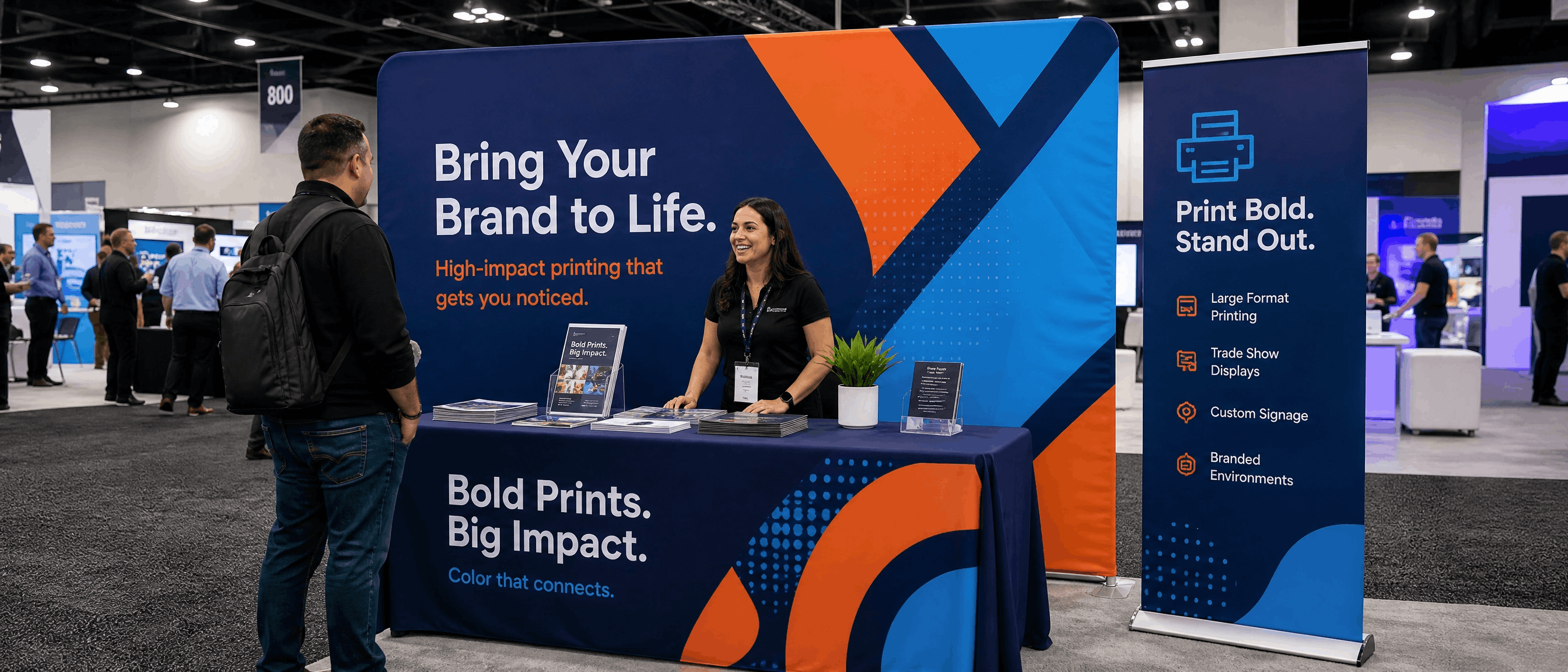
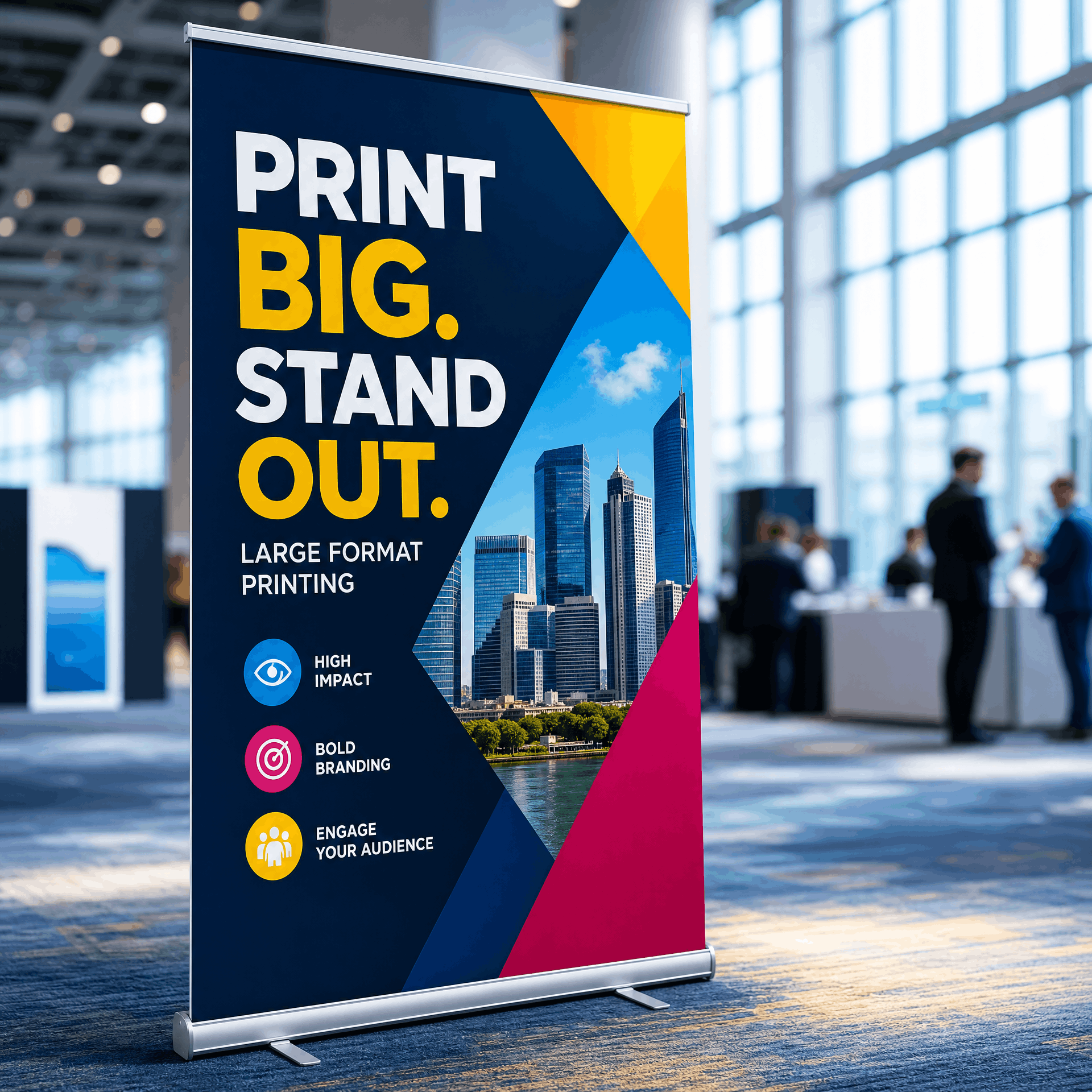
Large format printing is essential for trade shows, retail, and events because it turns booth space, storefronts, and venues into attention-grabbing branded environments that smaller print materials simply cannot achieve. A banner visible from across a convention hall, a window graphic that stops foot traffic on a busy retail block, or a backdrop that anchors every photo taken at a corporate event all rely on the same thing: printing at a scale big enough to be seen and remembered. Large format printing gives businesses that scale, whether the goal is filling a 10x20 trade show booth or refreshing a storefront window for a seasonal promotion.
This matters because attention at a trade show, in a retail aisle, or at a live event is won or lost in seconds. A crowded show floor or a busy shopping strip gives a business almost no time to make its case, and undersized graphics get lost in the noise. Investing in the right large-format pieces, sized and designed correctly, is often what separates a booth or storefront people actually stop at from one they walk right past.
The term covers a wide range of oversized printed materials built for high-visibility spaces:
Because these formats serve different environments, matching the right product to the right setting is the first decision a business needs to make before ordering anything.
Most visitors make a split-second call on whether a booth is worth walking toward, often while they're still several rows away. That leaves little room for small print or busy layouts. Bold color contrast and one strong focal graphic tend to pull people in far more reliably than a booth trying to say everything at once.
Teams attending multiple shows per season should also plan for materials that pack down easily and hold up to repeated setup and travel.
Retail businesses face a similar attention problem on a smaller scale: shoppers walking past a storefront make a decision to stop or keep moving in a matter of steps. Window clings, hanging banners, and in-store signage give a retail location the same kind of instant visual presence a trade show booth needs on a busy floor.
A retail location that changes its large-format graphics with the season tends to read as active and current, which matters as much to foot traffic as the products on the shelves.
Conferences, product launches, community fairs, and internal company events all rely on oversized print to guide attendees and reinforce a brand or message throughout the venue. Directional and wayfinding sign printing helps attendees find registration desks, session rooms, or a sponsor's booth in a large or unfamiliar space without confusion.
These pieces do more than decorate a venue. They shape how attendees move through the space and where their attention lands.
Not every large-format piece needs to survive years of travel, but many do, and choosing the wrong material shortens the life of an otherwise good design. Businesses attending three or more shows a year get more value from heavier scrim vinyl and reinforced hardware than from lighter economy stock that tears or creases after a handful of uses.
Thinking about reuse before the first order goes to print usually costs less over time than replacing worn graphics every few events.
A design that looks sharp on a laptop screen does not always translate cleanly to an eight-foot banner. Large format artwork needs to be built for its final scale from the start, not scaled up after the fact.
Businesses without an in-house design team often lean on professional graphic design support to make sure sizing, resolution, and layout hold up once the file goes to press.
Booth graphics and storefront banners rarely work best on their own. The businesses that see the strongest results treat large-format pieces as the anchor of a broader marketing push rather than a standalone purchase.
A booth or storefront that combines a strong visual anchor with supporting print materials tends to convert more visitors into actual leads or sales.
A booth, storefront, or event space is only as effective as the materials representing it. Copies America produces banners, backdrops, signage, and supporting print materials under one roof, so everything a business brings to a show floor or storefront shares the same colors, fonts, and message. Whether the need is a single retractable stand or a full booth package for a 10x20 space, Copies America can help plan the footprint and turn it around on a schedule that fits the event date. Contact Us to talk through booth size, venue, and timeline, and get a plan and quote back the same business day.
Large format printing refers to oversized printed materials such as banners, backdrops, window graphics, and rigid signage, typically anything printed wider than standard poster size. It covers the display pieces businesses use at trade shows, retail storefronts, and events where visibility from a distance matters more than fine print detail.
Most large-format orders need 5 to 7 business days from final artwork approval, though retractable stands with in-stock hardware can move faster. For a fixed event date, it helps to loop in a printer early, even before artwork is finished, since that leaves more room to hit a tight deadline without rush fees.
A single backdrop banner paired with one or two retractable stands typically fills a 10x10 booth without crowding the space. Adding more graphics than that tends to compete for attention rather than reinforce a single clear message, which works against the goal of catching attendees' eyes from a distance.
Yes, retail locations commonly use window clings, hanging banners, and in-store signage to refresh a storefront for a new season or sale without a permanent remodel. Swapping graphics on a seasonal schedule keeps a location looking current, which tends to support foot traffic as much as the products inside.
Large format artwork should be built at full size or a proportional fraction of it, at a minimum of 100 to 150 DPI, since standard 300 DPI web images will not scale cleanly to an eight-foot banner. Sending a high-resolution PDF with outlined fonts is the safest way to avoid blurry or pixelated results at full scale.
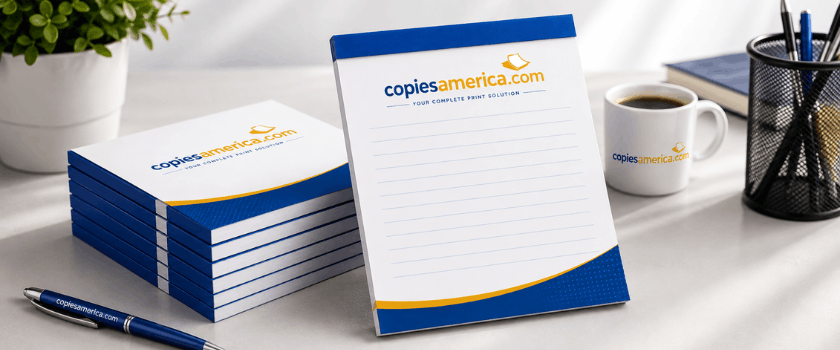
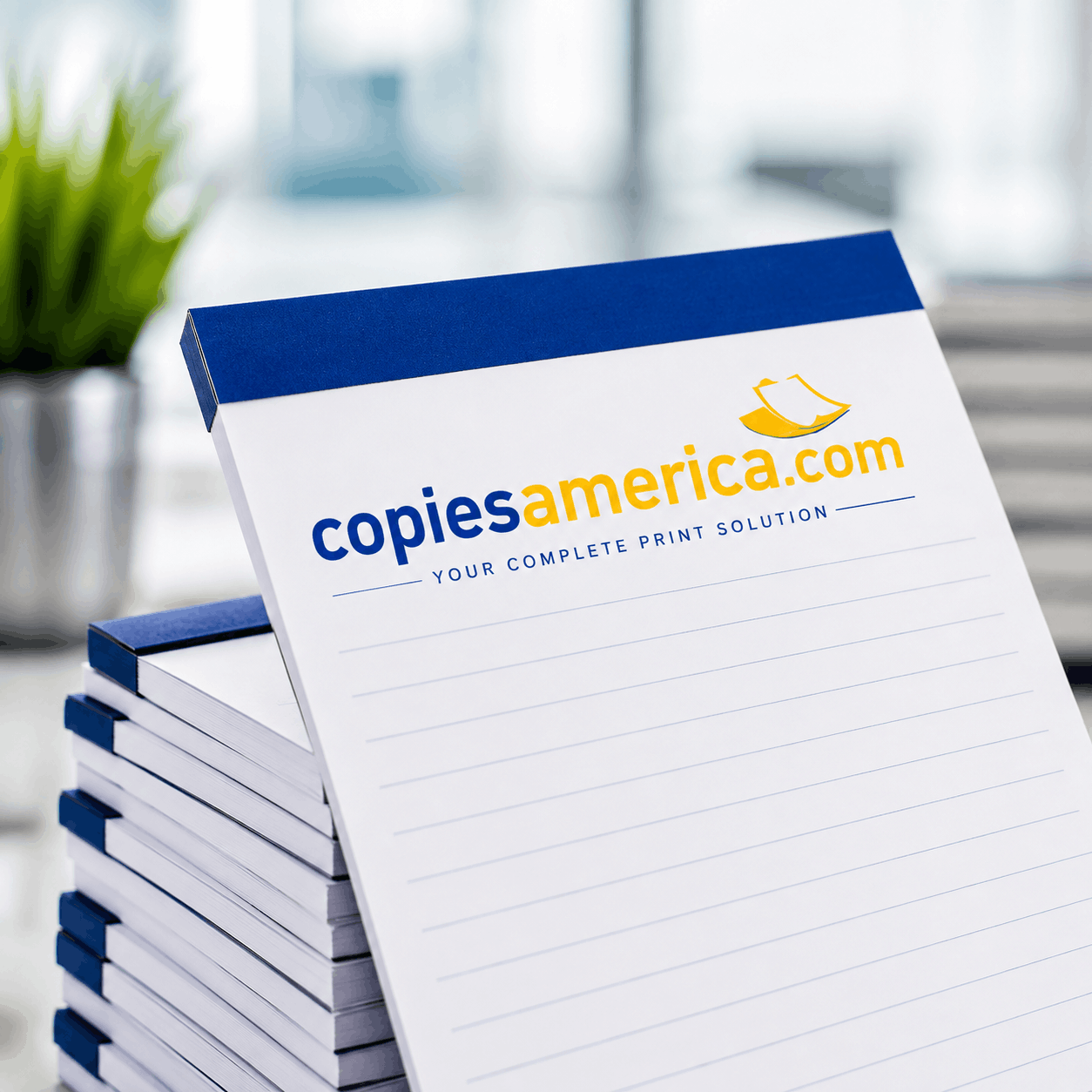
Promotional notepads keep your brand in front of customers every day because a notepad doesn't get filed away, deleted, or thrown out after one glance the way most marketing materials do. It sits on a desk, gets picked up for a phone message, and puts your logo back in front of someone every single time they reach for it. Promotional notepads turn an everyday office habit into dozens of small, repeated brand impressions that a flyer or a one-time mailer simply can't match.
That repetition is exactly what makes this format worth budgeting for. A business card gets glanced at once and tucked into a drawer, but a notepad sitting on a receptionist's counter or a client's desk gets used, and seen, over and over across weeks or months. For businesses trying to stretch a marketing budget further, promotional notepads deliver a lot of visibility per dollar spent, especially compared to items that only make one impression before they're gone.
A notepad has a job to do beyond carrying your logo, and that practical use is exactly why it sticks around longer than most promotional items.
That combination of usefulness and visibility is hard to replicate with disposable print items that get read once and discarded.
Not every notepad needs to be the same size or thickness, and matching the format to its actual use makes a real difference in how long it lasts and how it's perceived.
Thinking through where the pad will actually sit before ordering helps avoid ending up with a size that's either too small to be useful or larger than the use case calls for.
Some businesses see a faster return on branded notepads than others, simply because of how often the pad gets used and seen:
If your team regularly meets with clients face to face or staffs a booth at events, a branded pad tends to earn its cost back quickly in ongoing visibility.
The paper a notepad is printed on affects more than durability. It shapes how the whole item feels in someone's hands.
Choosing stock based on how the pad will be perceived, not just how it will be written on, is a small decision that changes the overall impression it leaves.
The design on a notepad is limited to a small header space, so it has to work harder than a full-page layout would.
Businesses without a print-ready logo file often work with a graphic design team to build a clean header from an existing brand mark before the first order goes to print.
A notepad rarely travels alone. Businesses that build a full branded stationery set tend to make a stronger, more consistent impression than those relying on a single item.
Ordering these pieces together also tends to simplify paper stock and color matching across the whole set.
A few file setup details are specific to notepad printing and worth confirming before submitting artwork.
Businesses planning notepads as an event giveaway alongside other branded items sometimes coordinate that order with custom giveaways to streamline production and shipping around a single event date.
A notepad is a small item that does an outsized amount of quiet, repeated marketing work once it lands on the right desk. Copies America prints promotional notepads on a range of paper stocks and sizes, with fast turnaround for businesses ordering ahead of a client meeting, event, or office refresh. Whether you already have a logo ready to go or need help building a simple header design, the Copies America team can walk through paper, size, and sheet count before anything goes to print. Contact Us to get a quote and place your order.
Promotional notepads work best as a practical, repeat-use branding item for offices, client meetings, and event giveaways. Because they get used and reordered over time rather than discarded after one glance, they generate far more repeated brand visibility than most one-time printed handouts.
Custom notepads are typically available in a compact message-pad size, a half-letter size for general office use, and a full letter size for meeting notes or longer to-do lists. The right choice depends on how much writing space the person using the pad actually needs day to day.
Sheet counts commonly range from 25 to 100 per pad, with lower counts suited to giveaways and higher counts better for high-traffic desks that go through pages quickly. A higher sheet count also means the pad stays in use, and visible, for a longer stretch of time.
Full color is the better choice for logos with multiple colors or a branded header design, while black and white can lower cost on large orders when the logo is already single-color. Either option is typically printed on the front of the sheet only, keeping the back clear for writing.
Most printers set a minimum order around 25 notepads, which keeps the format accessible for a single office or a smaller giveaway run. Larger quantities, often several hundred pads or more, typically bring the per-unit cost down for multi-location businesses or bigger event giveaways.
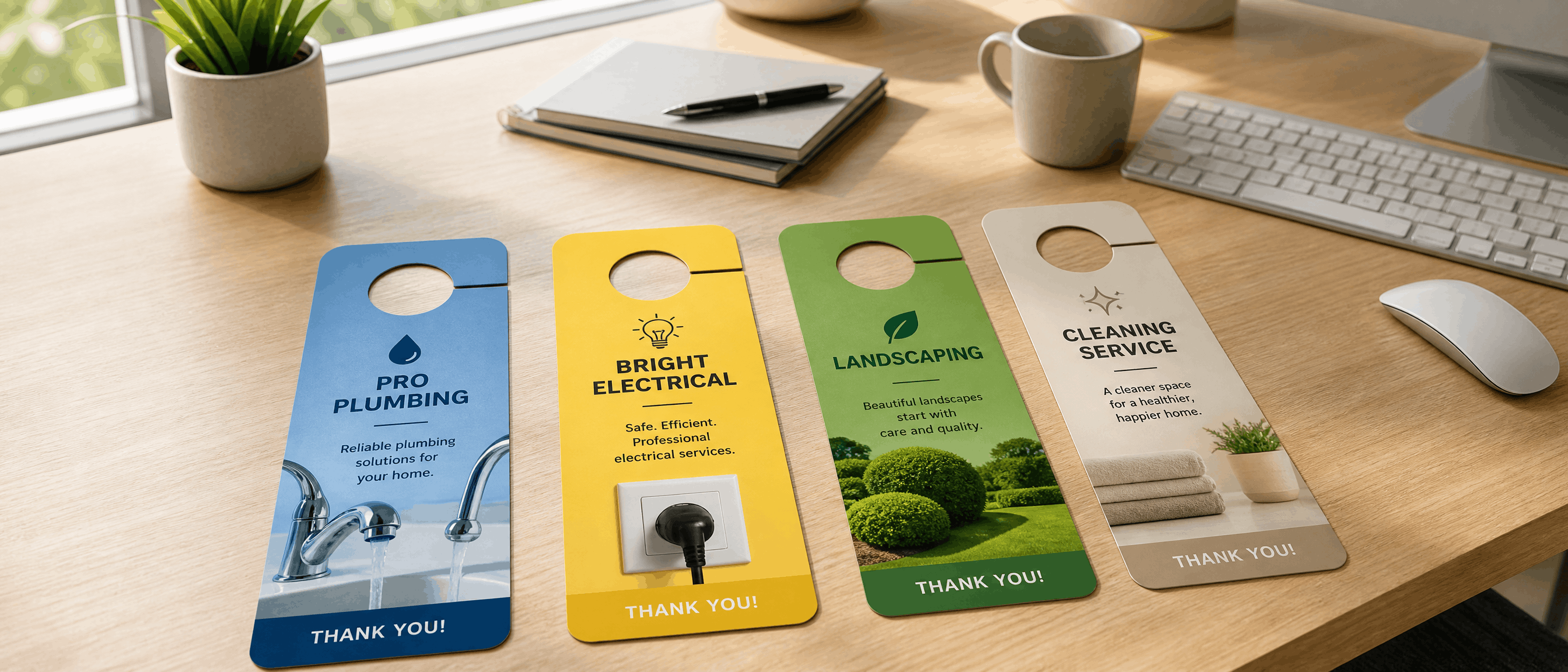
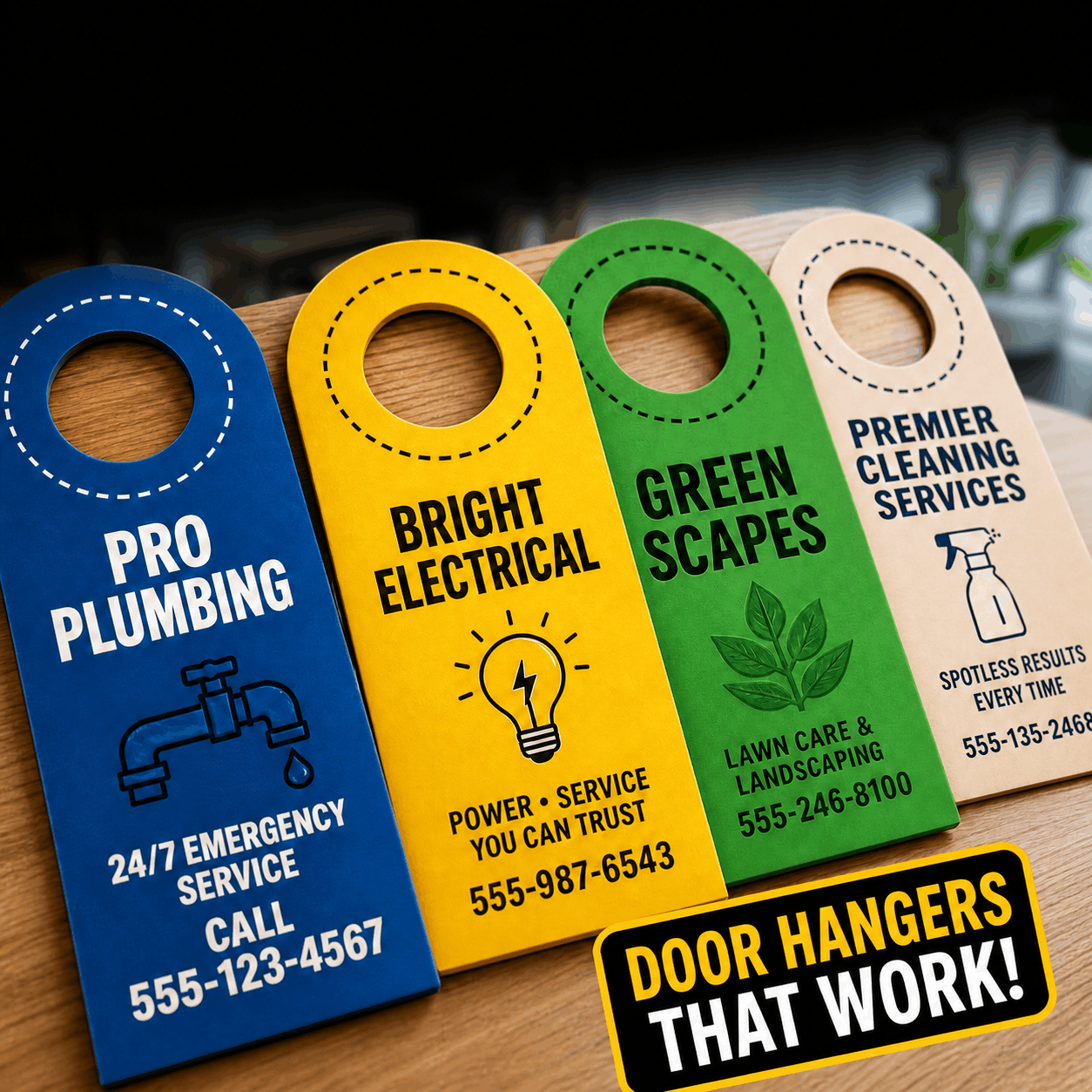
Custom printed door hangers help local businesses increase customer reach by placing a branded message directly on a prospect's doorknob, where it cannot be skipped in an inbox or scrolled past on a feed. For a plumber working a specific zip code, or a real estate agent farming a subdivision, custom printed door hangers turn a single afternoon of distribution into hundreds of guaranteed impressions. Every recipient sees the message at eye level the moment they get home, with no algorithm deciding whether it gets shown.
That kind of guaranteed visibility matters more in 2026 than ever. Inboxes are crowded with promotional email, and paid social ads compete for attention against dozens of other posts. Custom printed door hangers cut through that noise with a physical, unmissable format that recipients touch, read, and often hold on to. For businesses that depend on local visibility, that kind of direct-to-door reach is hard to replicate through any digital channel alone.
Most local marketing pieces compete for attention in a crowded space, a stuffed mailbox, a busy news feed, a cluttered countertop. Door hangers work differently.
This direct placement is why door hanger marketing consistently produces strong response rates for businesses working a defined local territory.
A door hanger campaign works best when it is treated as one piece of a broader local outreach plan rather than a standalone effort. Pairing custom printed door hangers with other local outreach, such as direct mail services, helps a business build repeated visibility with the same households over time.
Repetition is what turns a one-time impression into brand recognition. A homeowner who sees a landscaper's door hanger, then receives a postcard from the same company two weeks later, is far more likely to remember the name when they actually need the service.
Door hanger marketing performs especially well for businesses whose customers live within a defined service radius:
These businesses often supplement door hanger drops with business cards left with the hanger or handed out during follow-up visits, giving recipients an easy way to hold on to contact information.
Not every campaign calls for the same door hanger format. The right choice depends on what action you want the recipient to take.
Choosing between the two comes down to whether the goal is broad awareness or a measurable response.
A well-designed door hanger earns a second look instead of an immediate toss in the recycling bin.
Businesses without an in-house designer often turn to professional graphic design support to make sure the layout, color choices, and messaging hierarchy are optimized before printing.
Door hangers rarely perform best in isolation. Businesses that combine them with complementary print formats tend to see stronger overall campaign results.
This layered approach builds familiarity gradually, which is often what moves a household from noticing a business to actually contacting one.
Getting the logistics right matters as much as the design itself.
Consistent, well-timed distribution is what separates a door hanger campaign that gets noticed from one that gets ignored.
A strong local marketing push starts with a door hanger that looks professional and holds up outdoors. Copies America has been printing for businesses across the country for more than four decades, with full color printing on heavy cardstock and fast turnaround for campaigns on a deadline. Whether you need a simple standard hanger or a tearoff design built around a coupon, Copies America can help you get the right format, size, and finish for your audience. Contact Us today to talk through your campaign and get a quote.
The standard size is 4.25" x 11" with a die-cut slot for hanging on a door handle. This size fits residential and most commercial door handles and is the industry standard used across nearly all door hanger campaigns, making it the safest default for most businesses.
Most local campaigns start with 500 to 1,000 pieces, since a typical residential block has 20 to 30 homes. This range covers a focused service area while keeping per-piece costs low through volume pricing on larger orders.
Standard door hangers are one solid piece meant for brand messaging, while tearoff door hangers include a perforated section recipients can remove. Tearoff formats work best when a campaign needs a trackable action, like a coupon code or appointment reminder.
Yes, door hangers are widely used for just-listed, just-sold, and neighborhood farming campaigns. They let agents reach every household on a specific street directly, which is difficult to replicate with broader digital or mail advertising.
Gloss coating makes colors vibrant and works well for bold, photo-heavy designs, while matte gives a more understated, professional finish. Both hold up equally well outdoors, so the choice comes down to brand style rather than durability.
.png)
Perfect bound book printing is ideal for professional marketing materials because it combines a polished appearance, durability, and premium print quality that enhances how businesses present their brand. Whether you're showcasing products, sharing company information, or providing training resources, professionally bound books create a stronger impression than loose pages or stapled documents.
Investing in perfect bound book printing allows businesses to present catalogs, company profiles, annual reports, and sales materials in a format that reflects professionalism and builds customer confidence. As competition continues to increase across industries, high-quality printed marketing materials remain an effective way to communicate your brand, educate prospects, and support long-term business growth.
Presentation matters when introducing your business to clients, investors, or partners. Premium printed materials demonstrate attention to detail and reinforce your company's commitment to quality.
Businesses choose perfect bound books because they offer:
To create a complete presentation package, many companies distribute bound books alongside professionally printed presentation folders during meetings and sales presentations.
Marketing materials should educate prospects while reinforcing your company's credibility. Professionally bound publications provide an organized way to present detailed information without overwhelming readers.
Common applications include:
Businesses often include professionally designed brochures as quick-reference materials while using perfect bound books for more detailed information.
Nearly every industry can benefit from professionally printed bound books when sharing detailed content with customers or employees.
Examples include:
Professionally designed graphic design services help ensure every page aligns with your company's branding and communicates information effectively.
Unlike basic stapled documents, perfect binding printing provides a durable finish that protects your content while creating a polished appearance suitable for repeated use.
Benefits include:
This makes perfect bound books an excellent choice for businesses that regularly distribute catalogs, manuals, or informational publications.
Not every marketing piece requires a bound book, but longer-form content often benefits from a professional binding solution.
Businesses commonly use custom bound book printing for:
Adding professionally printed business cards inside presentation packages also makes it easier for customers to connect with your team after reviewing your materials.
Printed publications continue to play an important role in business marketing because they provide customers with a tangible resource they can reference at any time. Unlike digital files that are often overlooked, professionally bound books encourage readers to spend more time engaging with your content.
Businesses frequently combine direct mail services with premium bound books for targeted campaigns, helping them deliver high-value marketing materials directly to qualified prospects while increasing brand visibility.
Professional publications help businesses communicate expertise, showcase products, and strengthen customer trust. Investing in perfect bound book printing allows you to present detailed information in a durable, attractive format that reflects the quality of your brand.
At Copies America, businesses can create professionally printed bound books for catalogs, company profiles, training manuals, marketing guides, and more. Whether you're preparing materials for clients, employees, or events, our commercial printing solutions help your business make a lasting impression.
Ready to produce premium bound books for your business? Contact Us today to discover how Copies America can help you create professionally printed marketing materials that support your business goals.
Perfect bound book printing is a professional binding method that uses strong adhesive to attach pages to a softcover, creating a clean square spine. This binding style produces durable, high-quality books commonly used for catalogs, company profiles, manuals, reports, and other professional marketing materials.
Perfect bound books are used by businesses that need to present detailed information professionally. Manufacturers, healthcare organizations, educational institutions, marketing agencies, retailers, financial firms, and corporate businesses commonly use them for catalogs, training manuals, portfolios, annual reports, and sales materials.
Perfect bound book printing is ideal for marketing materials because it creates a polished, durable, and organized presentation. The professional finish enhances brand perception, improves readability, and allows businesses to showcase products, services, and company information in a format customers are more likely to keep.
Perfect bound books typically work best for publications with 28 pages or more. This binding method is designed for longer documents, making it suitable for catalogs, manuals, magazines, company profiles, and detailed marketing guides that require a durable and professional finish.
Perfect bound books use adhesive to create a square spine, while saddle-stitched booklets are stapled along the fold. Perfect binding offers a more premium appearance, supports higher page counts, and provides greater durability, making it better suited for professional business publications.
Get insider tips about printing, design, marketing and more on your favorite social network.




Enter your registered email address to reset your password. An email will be sent to your registered email address with a password reset link
If you don’t remember your email address please give us a call during normal business hours 9:00 am – 7:00 pm EST at 1-800-423-2679 or leave a voice mail and we will return your call next business day.
Don’t have an account?
Create a new account



.png)