
Variable data printing (VDP) is a digital printing process that personalizes each piece in a print run with unique information - a different name, address, offer, image, QR code, or any combination of data fields - without stopping the press or changing the setup. Every piece shares the same base design but carries content specific to the individual recipient. The result is a marketing piece that speaks directly to the person holding it rather than broadcasting a generic message to everyone on the list.
Personalization works. Direct mail response rates for variable data campaigns consistently outperform static campaigns by a significant margin - industry research shows personalized direct mail can produce response rates two to five times higher than identical non-personalized pieces. When a recipient sees their name, their neighborhood, a relevant offer matched to their purchase history, or a property address specific to their area, the piece stops being junk mail and starts being relevant communication. That shift in perception is what drives response.
Copies America produces variable data printing for direct mail campaigns, personalized promotional pieces, event materials, loyalty communications, and more. We manage the data merge, the template design, the press run, and the mailing - as a single integrated service. You provide the data file and the campaign objective. We handle the rest.
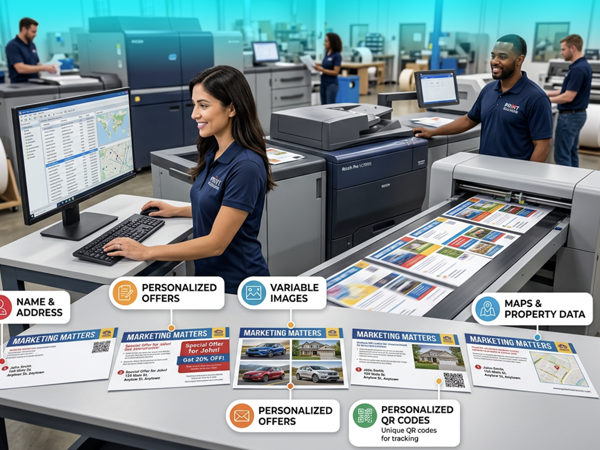
| Name and Address | The most basic level of personalization - the recipient's name in the salutation, headline, or body copy, and their mailing address on the address block. Even simple name personalization increases open rates and engagement compared to non-personalized pieces. Every variable data job we produce includes correct name and address handling as the foundation. |
| Personalized Offers | Different offers, discounts, or messages printed on different pieces based on the recipient's segment - new customers receive an acquisition offer, lapsed customers receive a win-back discount, loyal customers receive a VIP appreciation message. Segmented offers consistently outperform blanket promotions because the message matches the recipient's relationship with your business. |
| Variable Images | Different images printed on different pieces based on recipient data - a real estate agent's farming postcard showing the specific neighborhood the recipient lives in, a retailer's mailer showing products in the category the customer most frequently purchases, or a service company's piece showing a home type that matches the recipient's property record. |
| Personalized QR Codes | A unique QR code on each piece that links to a personalized landing page (PURL - personalized URL) pre-populated with the recipient's information. When the recipient scans the QR code, they land on a page that already knows who they are - reducing friction and increasing conversion. PURL campaigns provide precise individual-level response tracking. |
| Maps and Property Data | Neighborhood maps, property value estimates, market statistics, or address-specific data printed on each piece. Real estate agents use property-specific variable data to show homeowners their estimated home value, nearby recent sale prices, and local market conditions - making each piece directly relevant to the specific recipient's situation. |
| Transactional and Account Data | Account balances, loyalty point totals, membership renewal dates, subscription status, or purchase history data merged from your CRM or database into the printed piece. Transactional variable data turns a marketing piece into a personalized account communication - the kind recipients read rather than discard. |

| Personalized Postcards | The most common variable data application - a postcard with the recipient's name in the headline, a personalized offer, and a unique QR code linking to a personalized landing page. Personalized postcards are used across real estate, financial services, retail, healthcare, and home services with consistently strong response rates. |
| Personalized Brochures | Brochures where the cover headline, interior offer, or featured product content changes based on the recipient's segment or purchase history. Effective for insurance and financial services companies that need to present different products to different audience segments using the same base template. |
| Direct Mail Letters | Personalized letter packages with the recipient's name in the salutation and personalized content in the body - account summaries, renewal notices, personalized offers, and benefit statements. Letters with genuine personalization beyond just the name field produce significantly higher response than form letters with only a name merge. |
| Event Invitations and Tickets | Individual event invitations with the recipient's name, a personalized RSVP link, seat assignment, or ticket number printed on each piece. Event tickets with unique barcodes or QR codes for scanning at entry. Award certificates and recognition pieces with individual names, titles, and achievement details. |
| Loyalty and Membership Communications | Membership renewal notices with account expiration dates, loyalty program statements with individual point balances and redemption offers, and anniversary communications acknowledging the specific length of the customer relationship. Loyalty communications with individual account data feel personal rather than mass-produced - because they are. |
| Nonprofit Fundraising Appeals | Donation appeals with the donor's previous giving amount, suggested upgrade ask, and personalized acknowledgment of their contribution history. Personalized fundraising appeals consistently outperform generic appeals - donors respond to being recognized as individuals rather than as names on a list. |

| Step 1 Data File Preparation |
You provide a data file - typically a CSV or Excel spreadsheet - with one row per recipient and columns for each variable field: name, address, offer code, segment, image selection, or any other data point that will drive personalization. We review the file for completeness, format consistency, and any data quality issues before production begins. Clean, well-structured data is the foundation of a clean variable data print job. |
| Step 2 Template Design |
We design the base template with designated variable fields marked for data merge - the fixed design elements that stay the same on every piece, and the variable zones where personalized content is inserted. For jobs with variable images, we build the image library and the logic that maps each recipient to the correct image. The template is proofed before merging begins. |
| Step 3 Data Merge and Proof |
The data file is merged into the template and a sample proof set is generated - typically showing the first, last, and a mid-run record, plus any records with unusual data lengths or special characters that need review. We review the merged proof for alignment, text overflow, image placement, and data accuracy before approving the full run for production. |
| Step 4 Digital Press Run |
The merged file is sent to our digital press. Because each piece prints from a unique file, the press runs continuously without interruption - the personalization happens in the RIP (raster image processor) before each sheet is printed. Press output is monitored throughout the run for color consistency and print quality. |
| Step 5 Finishing and Mailing |
Finished pieces go through cutting, folding, or other finishing as required, then move directly to addressing, sorting, and USPS drop-off. For variable data direct mail jobs, the data file that drove the print personalization also drives the addressing and sorting - ensuring every piece is matched to the correct recipient through the entire production chain. |

| Real Estate Professionals | Agents and brokers using personalized farming postcards with neighborhood-specific market data, individual home value estimates, and recent sale comparables. Each homeowner in the farm receives a piece that references their specific property and local market conditions - producing engagement rates that generic farming mailers cannot match. |
| Financial Services | Banks, credit unions, insurance companies, and financial advisors using personalized account statements, renewal notices, product offer letters, and investment summaries. Financial services VDP typically involves sensitive account data - we handle all data securely and maintain strict data handling protocols throughout production. |
| Retail and E-Commerce | Retailers using purchase history data to send customers personalized offers on the product categories they buy most frequently, win-back campaigns with offers calibrated to the customer's average order value, and loyalty program statements with individual point balances and personalized redemption incentives. |
| Healthcare | Medical practices, health systems, and insurance companies using personalized appointment reminders, wellness program communications, benefits enrollment materials, and patient education pieces customized to the individual's health profile or plan. Healthcare VDP requires careful attention to HIPAA compliance - we discuss data handling requirements before any healthcare variable data job begins. |
| Nonprofits | Charities and nonprofits using personalized fundraising appeals with individual giving history, suggested ask amounts based on previous donation levels, and personalized acknowledgment of the donor's specific impact. Personalized fundraising consistently outperforms generic appeals and is now considered standard practice for organizations serious about donor retention. |
Variable data printing (VDP) is a digital printing process that produces a run of printed pieces where each piece contains unique personalized content merged from a data file. Every piece shares the same base design template, but designated fields - name, address, offer, image, QR code, or any other data point - are populated differently for each recipient from a supplied database. The press runs continuously without stopping between pieces; the personalization is applied in the digital workflow before each sheet is printed. VDP requires digital printing - offset printing with plates cannot produce variable output because every impression from an offset plate is identical.
The most common and easiest format is a CSV (comma-separated values) file or an Excel spreadsheet with one row per recipient and one column per variable field. Column headers should clearly identify each field - First Name, Last Name, Address, City, State, Zip, Offer Code, and so on. Data should be clean and consistent - no merged cells, no blank rows, no formatting in the cells, just plain text data. If your data is in a CRM or database, export it to CSV before submitting. We review all data files before production begins and flag any issues - inconsistent formatting, fields that are too long for the designated print area, or missing data - before they become press problems.
A PURL (personalized URL) is a unique web address printed on each piece that takes the recipient to a landing page pre-populated with their information. For example, a postcard might direct John Smith to johnsmith.yourcompany.com, where a form is already populated with his name and contact details. When he submits the form, you know exactly which piece he responded to, when he responded, and what he submitted. PURLs provide individual-level response tracking that standard direct mail cannot deliver, and the pre-populated landing page reduces friction at the point of conversion. We set up PURL campaigns in coordination with your web team or landing page provider.
Variable data printing at Copies America is available from 100 pieces. There is no practical upper limit - VDP jobs routinely run into the tens and hundreds of thousands of pieces. For very small quantities under 100 pieces, the setup time for data merge and template configuration may not be economical relative to the print cost - contact us and we will advise on whether VDP is the right approach for your specific quantity and personalization requirements. Larger VDP jobs benefit from lower per-piece print costs, and the setup cost is amortized across the run in the same way as any other print job.
The template should be a print-ready design with designated zones clearly marked for variable content - each zone sized to accommodate the longest expected data entry without overflow. For variable text, use a consistent font and size across all variable fields and plan for name length variation - "Al Jones" and "Christopher Bartholomew" occupy very different space in the same text field. For variable images, all images in the library should be the same dimensions and resolution (300 DPI minimum). Submit the template as a print-ready PDF or InDesign file with the variable zones noted. If you are new to variable data template setup, contact us before you begin design and we will provide a specification sheet for your specific job.
Yes - and this is the most common way VDP jobs are run at Copies America. The variable data print job and the mailing are managed as a single integrated workflow. The same data file that drives the print personalization also drives the addressing, sorting, and USPS documentation for the mailing. Every personalized piece is matched to the correct recipient through the entire production chain - print, address, sort, and drop-off. This integration eliminates the risk of mismatched pieces and the logistical complexity of coordinating a variable data print job with a separate mailing house.
Data submitted for variable data printing jobs is used only for the production of that specific job and is not shared with third parties. Files are transmitted securely and stored only for the duration of the production process. For jobs involving sensitive personal data - financial account information, healthcare data, or other regulated categories - contact us before submitting files to discuss the specific data handling protocols that apply. We follow strict data handling practices and can execute non-disclosure agreements for clients with contractual data security requirements.
Variable data printing carries a per-piece premium over standard static printing because each piece requires individual file processing through the RIP before it prints. The premium varies based on the complexity of the personalization - simple name and address merge adds a modest cost, while complex multi-field variable image jobs with PURL generation add more. In most cases the response rate improvement from personalization more than offsets the additional per-piece cost - a VDP campaign that produces twice the response rate of a static campaign at a 20 percent higher per-piece cost is still a significantly better investment. Contact us with your job specifications for a specific price comparison between static and variable data options for your project.


Complete the form below with your project details - product, quantity, data fields, and campaign objective - and our team will respond within 2 hours on business days. Prefer to talk? Call us at 1-800-423-2679 Monday through Friday, 8:00 AM to 6:00 PM EST. We will review your data file and advise on the best approach for your personalization goals.
Get insider tips about printing, design, marketing and more on your favorite social network.




Enter your registered email address to reset your password. An email will be sent to your registered email address with a password reset link
If you don’t remember your email address please give us a call during normal business hours 9:00 am – 7:00 pm EST at 1-800-423-2679 or leave a voice mail and we will return your call next business day.
Don’t have an account?
Create a new account